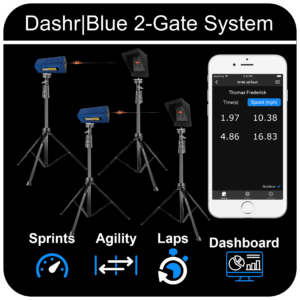
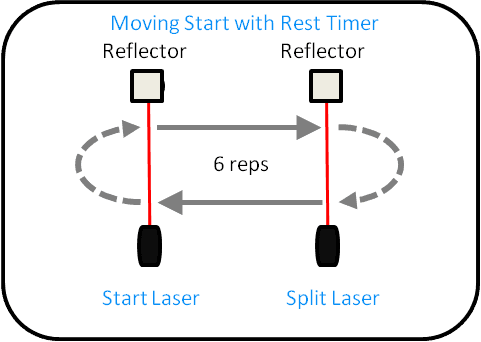
The Running Based Anaerobic Sprint Test (RAST) was devised at the University of Wolverhampton in the UK, and the standard version involves six sprints over 35 meters with a 10 second recovery between each sprint, and provides measurements of peak power, average power and minimum power along with a fatigue index (Draper & Whyte, 1997). This drill uses a moving start and requires 2 timing gates.
Step-By-Step Instructions
- Install/prepare batteries in each laser you plan to use.
- Install/open the Dashr app on your phone or tablet. (Create an account here if you have not already)
- Register each laser in the app (video below) – Press the “+” button at the top left of the main page or navigate to the “Device Registration” tile. Power on the lasers one at a time and select them from the “Available” list and assign them a number. Write that number on your laser. (This only has to be done the first time you use the laser with this phone/tablet)
- Return to the home menu and select RAST.
Select your timing equipment:
Dashr | Blue
- Screw 2 lasers onto 2 taller tripods, positioned so that the beam is around hip height.
- Screw 2 reflector onto 2 matching tripods and position laser and reflector across from each other (~6 ft)to create a line to pass through. (Standard RAST has these gates positioned 35 meters apart.)
- With the lasers on, select the appropriate laser from the drop-down menu and press the “Connect” button. If it does not work the first time, repeat.
- Once all devices are connected, press the “Start Testing” button.
- Check in the appropriate athlete (details here) – optional.
- On the testing page you will see a “Set” button that give you control of when a test starts. Press “Set” once the athlete is ready to take off. Once started, a “Reset” becomes visible to stop and reset the drill, or clear the time for the next athlete.
- Once the athlete crosses the first gate, the clock will start. First time is obtained when the next gate is crosses.
- At this point a countdown timer starts in the app (you can adjust this time in the connection page).
- As it runs down to 0, the athlete should start to sprint back to where they started.
- Repeat this for a total of 6 sprints.
- Determine the power output for each sprint using the following equations:
- Velocity = Distance (35m) ÷ Time
- Acceleration = Velocity ÷ Time
- Force = Weight × Acceleration- Power = Force × Velocity
OR
- Power = Weight × Distance² ÷ Time³
- From the six times, calculate the power for each run and then determine:
- Maximum power – the highest value
- Minimum power – the lowest value
- Average power – the sum of all six values ÷ 6
- Fatigue Index – (Maximum power – Minimum power) ÷ Total time for the 6 sprints
Dashr | Silver
- Place two Silver gates on the field, note that the standard RAST has these gates positioned 35 meters apart.
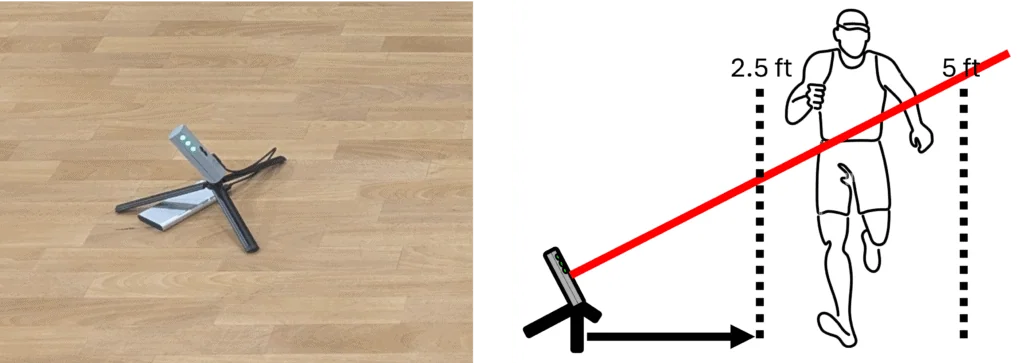
- With the lasers on, select the appropriate laser from the drop-down menu for the starting gate and press the “Connect” button. If it does not work the first time, repeat.
- Do the same for the other gate/laser.
- Once all devices (optional display/RFID) are connected, press the “Start Testing” button.
- Check in the appropriate athlete (details here) – optional.
- On the testing page you will see a “Set” button that give you control of when a test starts. Press “Set” once the athlete is ready to take off. Once started, a “Reset” becomes visible to stop and reset the drill, or clear the time for the next athlete.
- Once the athlete crosses the first gate, the clock will start. First time is obtained when the next gate is crosses.
- At this point a countdown timer starts in the app (you can adjust this time in the connection page).
- As it runs down to 0, the athlete should start to sprint back to where they started.
- Repeat this for a total of 6 sprints.
- Determine the power output for each sprint using the following equations:
- Velocity = Distance (35m) ÷ Time
- Acceleration = Velocity ÷ Time
- Force = Weight × Acceleration- Power = Force × Velocity
OR
- Power = Weight × Distance² ÷ Time³
- From the six times, calculate the power for each run and then determine:
- Maximum power – the highest value
- Minimum power – the lowest value
- Average power – the sum of all six values ÷ 6
- Fatigue Index – (Maximum power – Minimum power) ÷ Total time for the 6 sprints